Cream, Gel, Foam or Powder: Choosing a Men's Cleanser Texture
Texture is the decision that reaches furthest into a men's cleanser project, because it fixes the pump, the fill weight, the shelf-life conversation and the shelf presence all at once. Five formats are in circulation — cream, creamy, gel, foamy and powdered — and picking one narrows everything else. The brief is easier to write once the texture is chosen, not before.

Key takeaways
- Five texture formats are published for men's cleansers: cream, creamy, gel, foamy and powdered.
- Format sets the pack: a gel wants a pump, a cream a tube, a powder a shaker or sachet.
- Dose per wash decides the pack size, and it differs by format for the same cleansing job.
- Filling is where texture meets cost, because not every format runs on the same line.
The five formats and how they behave
Cream and creamy cleansers sit closest to each other. The distinction is body: a cream holds its shape in the hand, while a creamy formula is lighter and spreads faster. Both suit dry or mature skin, because the base carries more emollient and leaves less of a tight feel after rinsing.
Gel is the format most men's ranges reach for first. It spreads thinly, rinses quickly and pairs naturally with a pump. Foamy cleansers get their character from the dispenser rather than the formula, since a foaming pump aerates the product on the way out — which means the same base can be sold as a gel or a foam depending on the pack. Powdered cleansers are the outlier: no water in the formula, so they need a shaker or a sachet and a completely different filling arrangement.
Format decides the pack before the artwork
Choose the pack and the format together. A pump assumes a low-viscosity product; a tube suits a cream; a jar is generous but exposes the formula to fingers; a shaker or stick pack only makes sense for powder. Deciding the format after the pack is signed off is the usual way a launch slips, because the pack is the item with the lead time.
Decoration follows the same rule. A foaming pump with a printed collar, a tube with a flip top and a shaker all carry different minimums from their own suppliers, and those minimums sit outside the cleanser order.
Fill weight and dose per wash
Pack size is arithmetic dressed as branding. If a gel cleanser dispenses about 1.5 ml per wash and you want a product that lasts a two-month daily routine, that is 1.5 × 60 = 90 ml, which is why 100 ml and 150 ml are common gel sizes. A cream used in smaller amounts can sit comfortably in a 100 ml tube; a foaming product often ships at 150 ml because part of the volume is air.
Put both numbers in the brief — the dose you expect and the pack size you want — so the supplier can confirm the fill tolerance holds across a batch rather than only for the first units off the line.
| Choice | Published options | What it changes in the project |
|---|---|---|
| Texture format | Cream, creamy, gel, foamy, powdered | Pack type, dose per wash, filling line |
| Cleanser type | Soap-based, amino acid, compound, exfoliating | Skin feel, the test reports you will need, the claims you can make |
| Formula library | 10,000+ mature formulas | Whether the base starts from a proven system |
Judging texture at the sample stage
Texture is hard to describe in a sentence and easy to judge in the hand, so the sample round should be treated as a texture trial first and a fragrance trial second. Open the pack, dispense one dose, spread it and rinse. The three observations that matter are how the product leaves the dispenser, how much lather forms without a foaming pump, and how the skin feels a minute after rinsing.
Write the observations down with the date and the batch reference. A second sample compared against notes beats a second sample compared against memory, and the note is also what lets a supplier adjust in the right direction rather than guessing.
If two formats are still in play, ask for both in the intended pack. A gel in a pump and a cream in a tube settle the question in one round rather than two, because the dispenser is half the texture experience.
Reading the options chart
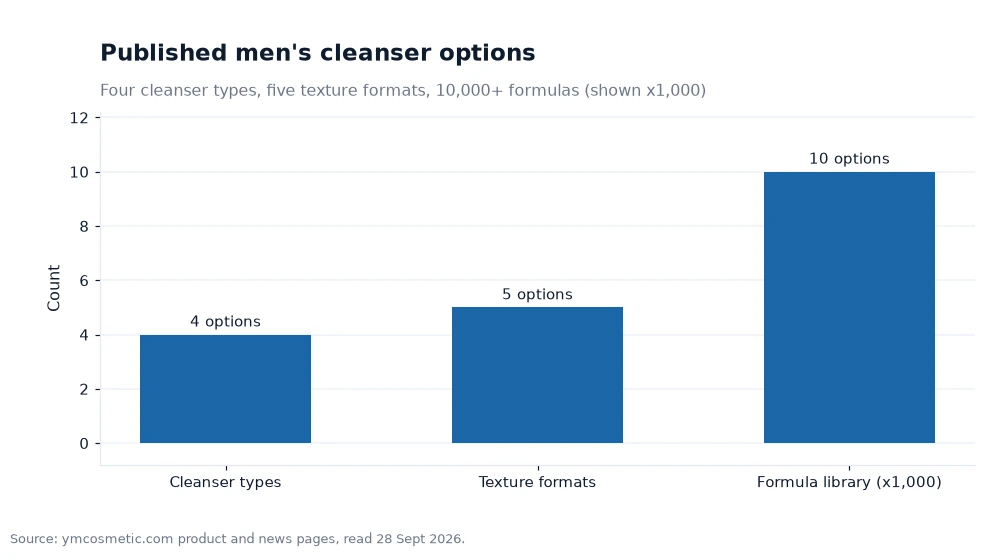
The first two bars are small and the third dwarfs them, which reflects how the decision actually works. Texture and type are narrow choices — a handful of options each — while the base itself can come from a library thousands of entries deep. Pick the two narrow ones first and the wide one becomes a shortlist rather than a search.
Worked example: dose, pack size and first-run economics
Take a foamy cleanser dosed at 1 ml per wash and used twice a day. Sixty days of use needs 1 × 2 × 60 = 120 ml of product, so a 150 ml pack covers it with room to spare. Switch to a cream dosed at 0.8 ml twice a day and the same sixty days need 0.8 × 2 × 60 = 96 ml, which fits a 100 ml tube exactly.
Now size the first run. At a published order band of 1,000–5,000 units, a 150 ml pack means 1,000 × 150 ml = 150 litres at the low end and 5,000 × 150 ml = 750 litres at the top. The 0.8 ml assumption and the washing frequency are mine; the pack sizes and the order band are the published figures.
Frequently asked questions
Can one formula be sold in two textures?
Sometimes. A gel and a foam can share a base because the dispenser does the work of aeration, which is why foaming pumps appear across otherwise similar ranges. A cream and a powder cannot share a base, because one contains water and the other must not.
Which texture is easiest for a first product?
A gel or a foamy format is usually the simplest starting point: the pack is widely available, the fill tolerance is straightforward, and the after-feel story is easy to describe on pack. Cream formats suit brands already selling to dry-skin buyers.
Does texture affect how long the project takes?
Only through the pack and the testing plan. The base work is similar, but a custom dispenser adds its own lead time, and a format that carries a specific claim may need extra compatibility work before the label copy is final.
Choosing the texture in one sitting
Answer three questions in order: who is washing with it, how much product should one wash take, and which pack do you want on the shelf. Those answers select the format, and the format selects the rest of the brief. Yunmei's product page for the men's facial cleanser range lists both the four types and the five texture formats in one place, and the OEM/ODM cosmetic manufacturing service explains how a chosen format moves from sample to filled pack. If the same brand extends into colour, the lipstick development page shows how differently a moulded product is specified.
Ymcosmetic.com published the texture formats, cleanser types and order quantities cited in this piece; my read date was 28 Sept 2026. The dose-per-wash figures and the pack sizes derived from them are my own worked assumptions.[1].