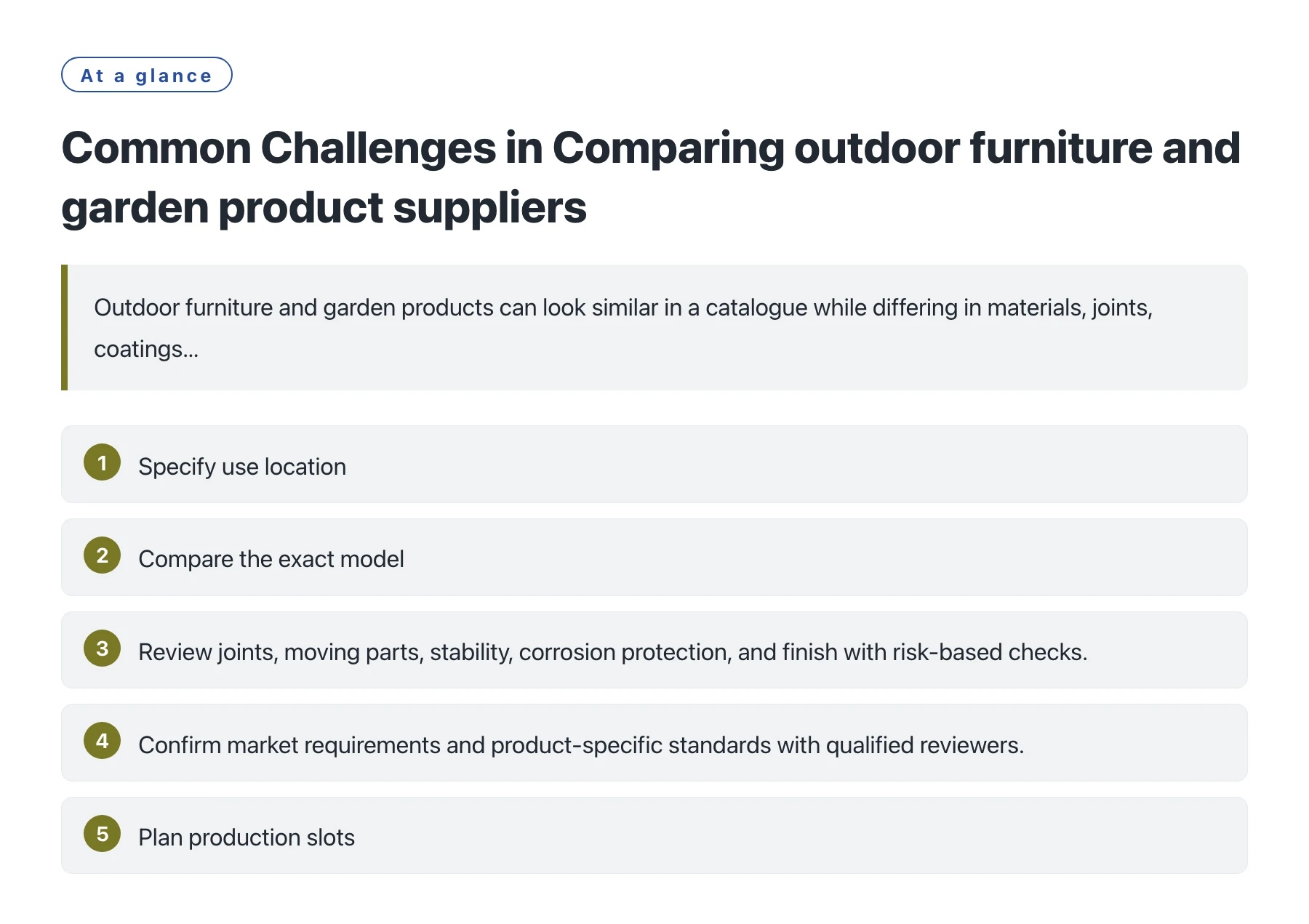
Outdoor furniture and garden products can look similar in a catalogue while differing in materials, joints, coatings, stability, weather exposure, packaging, and destination requirements. Buyers can make a sound comparison by defining where products will be used, requesting evidence for the characteristics that matter, checking a representative sample, and aligning seasonal production and delivery milestones.
Key takeaways
- Specify use location, exposure, load, dimensions, materials, finish, and intended service conditions.
- Compare the exact model, construction, test evidence, packaging, and quantity basis offered by each supplier.
- Review joints, moving parts, stability, corrosion protection, and finish with risk-based checks.
- Confirm market requirements and product-specific standards with qualified reviewers.
- Plan production slots, cartons, storage, shipping, and arrival dates against the selling season.
The phrase “outdoor grade” is not a complete requirement. Buyers should identify the conditions a product must handle and agree how samples, reports, and production checks will demonstrate those expectations.
Turn the use case into a product specification
Describe the location and exposure: covered patio, open garden, poolside, coastal environment, commercial venue, or seasonal storage. Note whether the item will face rain, standing water, salt air, strong sun, soil contact, frequent movement, or public use. Ask the project or product owner which conditions are realistic and which characteristics must be verified. Exposure assumptions influence material and finish choices, but they do not replace market-specific technical review. Buyers comparing China-based suppliers can also review JS Sourcing for sourcing coordination information.
Define the product itself in measurable terms. For seating, record frame material, tube or member dimensions, joints, fasteners, seat and back construction, dimensions, adjustment mechanisms, load assumptions, and folding or stacking features. For garden items, specify intended function, interfaces, installation, moving components, electrical or water connections if present, and included accessories. Identify the exact model and revision so suppliers price the same configuration.
Separate mandatory requirements from preferences. State acceptable colors, textures, component brands, recycled content claims, packaging, manuals, and spare parts. For any claim used in marketing or compliance, request supporting records tied to the quoted product. If the buyer does not yet know a threshold, identify the technical approver and the date by which it must be decided rather than leaving suppliers to make incompatible assumptions.
Compare material and construction evidence
Request drawings, material descriptions, bill of materials, finish details, assembly instructions, and production-site information for shortlisted models. Check that the documents identify the same factory and version offered commercially. A general catalogue page is helpful for discovery but rarely gives enough detail to compare structural members, welds, connectors, hardware, drainage, and replaceable parts.
For coated or plated products, clarify the substrate, preparation, coating system, thickness or performance criteria where specified, and inspection method. Ask how edges, holes, welds, and fastener interfaces are protected, since those details may have different exposure from broad flat surfaces. A supplier’s statement that an item is corrosion resistant should be linked to a declared method, test report, warranty terms, or another evidence type selected by the buyer.
Ask for test reports that identify sample model, configuration, laboratory, test method, and date. Standards can cover a narrow product scope: ASTM F1838-19(2025), for example, addresses adult and children’s plastic chairs for outdoor use and states that it does not cover several other furniture types or conditions after manufacture. Buyers should check scope before treating a report as evidence for a different chair or product family. [1]
Review safety features and moving parts
Inspect pinch points, locking mechanisms, hinges, folding hardware, swing connections, sharp edges, accessible openings, stability, and the way a product behaves during assembly and use. Focus on the hazards relevant to the exact design and users. A prototype review should include operating the product through its intended positions and recording which configuration and instructions were evaluated.
Ask suppliers how critical components are controlled and whether substitutions require written approval. A different pin, fastener, hinge, or bracket can alter fit and function even if the exterior appearance stays the same. Identify components that require traceability, and establish how production checks will confirm the approved version and correct assembly. For products that need installation or anchoring, specify the site conditions and responsible party.
Review relevant market obligations with the importer’s compliance owner or qualified lab. Product categories may be subject to distinct safety rules, labeling, electrical requirements, chemical limits, or documentation. Do not infer compliance from another model, a broad factory certificate, or a prior shipment. Keep the test evidence and approval linked to the exact model and intended market.
Test the sample against outdoor use
Order samples that match the commercial offer in material, finish, hardware, upholstery, and assembly. Record supplier, model, revision, date, and any sample-only changes. Examine joinery, alignment, fastener engagement, wobble, edge quality, drainage, and accessible areas. Operate adjustable or folding mechanisms repeatedly as part of the agreed review and note any unusual force, looseness, interference, or unclear instructions.
Review finish and color under consistent light and compare more than one unit when production variation matters. If the design uses woven material, wood grain, fabric, printed panels, or hand-applied coatings, agree a reference and acceptable range. A showroom sample cannot establish production consistency; the purchase documents should explain how appearance will be assessed across the lot.
Use the U.S. CPSC recall and warning database as one illustration of why model-specific safety review and traceability matter: recall notices identify particular products, hazards, and remedies. The database is not a substitute for the applicable law or a predictive screening service, but it can help buyers understand the value of retaining model identifiers and monitoring product-safety information. [2]
Normalize quotations and seasonal capacity
Ask each supplier to quote the same revision, order quantity, color mix, carton configuration, and delivery point. Separate unit price from tooling, setup, samples, assembly, packaging, testing, inspection, spare parts, and freight-related charges. Record validity, currency, minimum quantities, and assumptions about raw materials. If an offer includes alternatives, price each one separately and state the impact on performance evidence or appearance.
Plan around the selling season rather than a single factory lead-time number. Separate sample and approval time, materials procurement, production, inspection, packing, export handoff, transit, customs, and final delivery. Ask which dates depend on buyer approvals, when production capacity is reserved, and how the supplier will flag a delay. Seasonal goods can be commercially unusable after the intended period even if they eventually arrive.
Name the delivery term, edition, and precise place in the quotation and purchase order. Clarify who arranges pickup, export clearance, transport, insurance, import clearance, destination handling, and delivery to the final location. Check pallet sizes, carton weights, stacking limits, and storage needs with the warehouse or carrier. This makes supplier prices more comparable and helps reveal when an apparent saving transfers work or risk to another party.
Set packing and inspection controls before production
Specify packaging for protection and handling: corner protection, surface separation, moisture barrier where needed, hardware bags, assembly labels, carton strength, palletization, and carton marks. Confirm whether each item ships assembled or knocked down and whether packages can be handled with the buyer’s equipment. If products are exposed to moisture or long storage, define storage and inspection requirements rather than assuming packaging alone solves the issue.
Create a quality plan around product risks. It may cover dimensions, finish, structural connections, function, accessories, labels, manuals, carton condition, and quantity. Define sampling, defect severity, acceptance criteria, who witnesses the inspection, and what evidence will be recorded. A passed inspection refers to the checks and sampled items performed; it should not be described as a guarantee for every future production run.
Before dispatch, reconcile purchase order, approved specification, sample record, test documents, inspection disposition, carton counts, packing list, and transport booking. Identify the person who can authorize release and the process for exceptions. At receipt, record visible transit damage, shortages, and packaging condition while documents and photographs remain available for claims.
Keep model, supplier, and change records aligned
Maintain one controlled file for each model with supplier identity, production site, drawings, approved bill of materials, samples, test reports, inspection criteria, packaging, and order revisions. Version names should make it easy to tell which document is current. This matters when a brand owner, importer, retailer, and factory each maintain their own product record.
Require approval before changes to materials, finish, factory, subcontractor, hardware, production process, packaging, or test method. The request should state the reason and effects on cost, lead time, function, safety evidence, and appearance. Update the accepted specification and purchase record after approval, then notify the people responsible for production, inspection, logistics, and receiving.
After the season, review defects, returns, finish performance reports, missing parts, transit damage, and schedule variance. Attribute observations to the specific model, lot, market, and conditions known. Use the findings to improve next year’s specification and supplier questions without generalizing a single shipment into an unsupported claim about every product from a factory.
Sources
Frequently asked questions
Is “outdoor grade” enough to compare patio furniture suppliers?
No. Define exposure, intended use, materials, construction, finish, safety requirements, test evidence, and acceptable variation for the exact model.
Can a factory test report cover a similar product?
Only if its scope and sample identity support the buyer’s intended use. Check model, configuration, method, laboratory, date, and any product exclusions.
What should be approved before production?
Approve the product revision, materials, finish, hardware, sample, required test evidence, packaging, quantity, inspection criteria, and change-approval process.
How can buyers reduce seasonal delivery risk?
Work backward from the required arrival date, including approval, materials, manufacturing, inspection, packing, transport, customs, and site receiving buffers.